
Washington City Genealogy Sources
Washington City Genealogy works well because the city has an early pioneer footprint and a direct record trail. Washington City was settled in 1857 and incorporated in 1863, so the recorder, cemetery, county records, and state collections each hold a different part of the family story. The city recorder is the best place for municipal records from the incorporated era, while the cemetery keeps burial records that reach back to the 1850s. That gives researchers a useful mix of civic, burial, and county evidence when they are trying to place a household in the right year and the right place.
Washington City Genealogy at the City Recorder
The Washington City Recorder is the first municipal office to check when a family event or local question belongs inside the incorporated city. The office maintains historical city records, and that matters because Washington City was incorporated in 1863, only a few years after the first settlement push. The office is located at 111 N 100 E, Washington, UT 84780, and the phone number is 435-656-6300. For Washington City Genealogy, the recorder is useful for city-side proof, ordinance context, and the kind of local paper trail that can pin a family to a time and a place.
The recorder is especially helpful when a surname appears in later municipal work but the family line reaches back into the pioneer era. A city file can show when a household entered the civic record, while a county or cemetery source can show where that same family was before or after the city record began. Washington City Genealogy is strongest when those dates are read together rather than treated as separate stories.
The recorder still matters because it preserves the city-side paper trail that can confirm an address, a resolution, or a later municipal reference. When a surname appears in a city minute or an ordinance note, that entry can be used to lock the family into Washington City Genealogy with more confidence before the search moves into cemetery, county, or state sources.
Washington City Genealogy at the Cemetery
The Washington City Cemetery is one of the most useful burial sources for Washington City Genealogy because its records date back to the 1850s. That gives the cemetery real value for early settlers and for later descendants who need to confirm a death date, family cluster, or burial place. The cemetery office is located at 111 N 100 E, Washington, UT 84780, and the office shares the city phone number, 435-656-6300. Burial records can often supply the missing link between a family name in a newspaper and the same family in county or state sources.
Burial evidence matters even more when the city record set is thin. A cemetery entry can show a spouse, a child, or a shared plot that points to the larger household. In a city with roots as early as Washington City, the cemetery is not just a resting place. It is also one of the best ways to see how the first families stayed connected across generations.
Lead-in source: Washington City Cemetery.
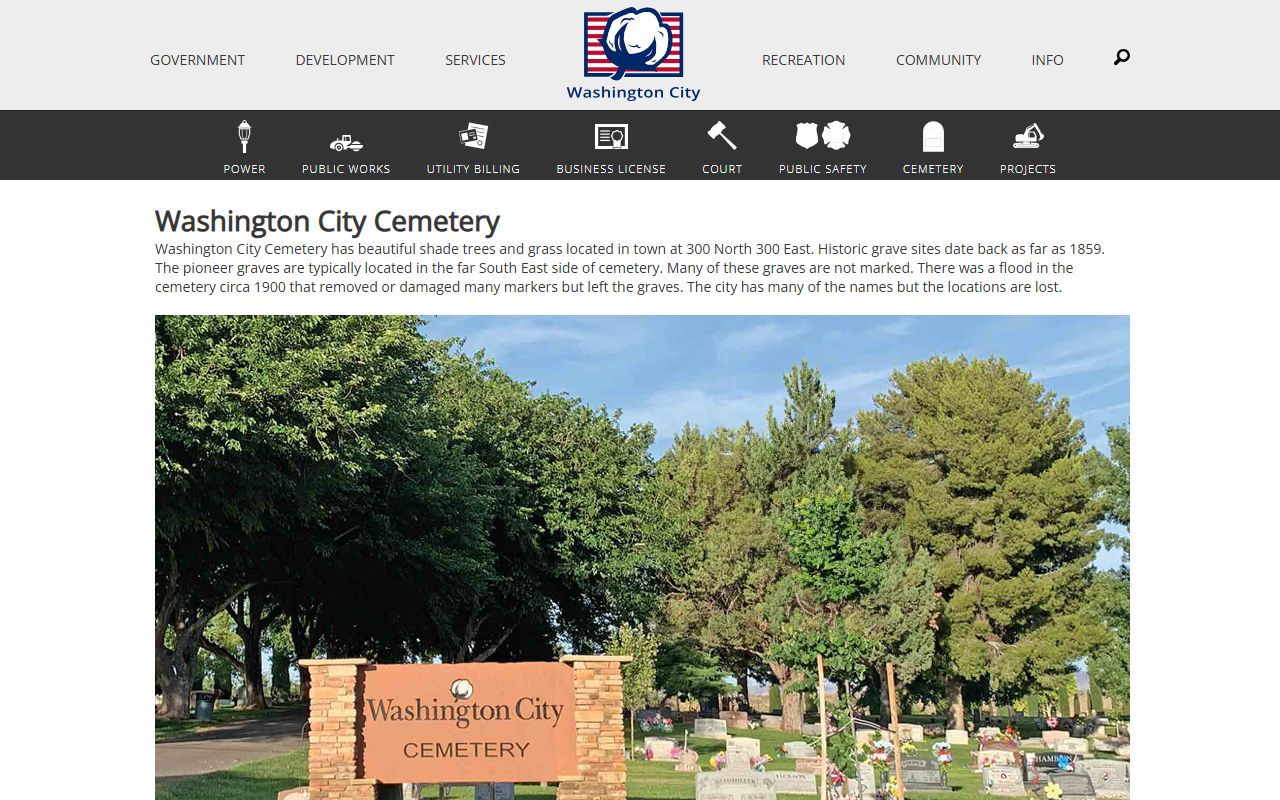
This cemetery image fits Washington City Genealogy well because burial records from the 1850s often answer the same family questions that the city recorder cannot.
Washington City Genealogy in County Records
Washington County is the broader setting for Washington City Genealogy, and the county page helps connect the city file to marriages, probate, land, and other civil records. If a family line appears before the city record begins or if a surname seems to drift between town and county references, the county layer is often where the first reliable clue appears. The Washington County Genealogy page brings the clerk, recorder, health department, newspapers, and state resources together in one place, which makes it a practical next stop after the city office.
County records matter because the city was settled within a larger southern Utah pattern. A family may show up in a land file, a probate packet, or a marriage record before it appears in a city summary. Washington City Genealogy becomes more complete when those county records are read as the earlier layer of the same household story. That approach also helps with spellings, moving households, and family groups that split across nearby places.
Washington City Genealogy and State Collections
State collections give Washington City Genealogy a wider frame. The Utah State Archives can add court and government context, Utah State History can help with place and cemetery background, and Utah Vital Records is the state route for modern certificates. If you need to understand how city, county, and state records fit together, the FamilySearch Utah Genealogy wiki and the Library of Congress Utah local history guide can help sort the record groups before you order copies or visit an office.
Those state sources are useful because Washington City families may appear in county or cemetery material long before a modern state certificate is the right document to request. When that happens, the state sources do not replace the city file. They explain what the city file means and how the earlier evidence fits around it.
Washington City Genealogy Newspapers and Clues
Utah Digital Newspapers is a strong companion to Washington City Genealogy because newspapers preserve the everyday details that government records often skip. Obituaries, funeral notices, church items, business references, and local announcements can all name relatives and show where a family lived at a given time. For Washington City, that is especially helpful because the city has enough age and continuity for a surname to appear in several record types across different decades.
Newspapers also help identify the right branch when a name is common. A brief notice may mention a spouse, a parent, or a burial place that can be checked against the cemetery and county records. Once those clues are lined up, Washington City Genealogy becomes much easier to verify and much harder to confuse with a neighboring family of the same name.
Washington City Genealogy Research Path
The best Washington City Genealogy search starts with the city recorder for municipal records from incorporation forward, then moves to the cemetery for burial evidence from the 1850s and later. After that, Washington County records fill in marriages, probate, land, and other civil work that may reach back before the city office was fully useful. That sequence follows the way the records were created, so it usually saves time and reduces false leads.
When the city, county, cemetery, and state sources are checked together, Washington City Genealogy turns into a connected trail rather than a set of separate lookups. That is the best way to keep one family in focus from pioneer settlement to later city life.