
West Jordan Genealogy Guide
West Jordan Genealogy research has a clearer city-history path than some newer municipalities because the area was settled in the mid-19th century even though the city itself was not incorporated until 1941. That means the city recorder can help with modern municipal records, but older family history usually lives in Salt Lake County, state repositories, newspapers, burial sources, and the West Jordan Historical Society. The best approach is to start with the city office for post-incorporation records, then move backward into the county and state layers that capture the earlier settlement period.
West Jordan Genealogy at the City Recorder
The West Jordan City Recorder maintains city records from incorporation forward. That is useful for West Jordan Genealogy when you need ordinances, resolutions, or another municipal record tied to a later family event or a property question. The recorder office is at 8000 S Redwood Road, West Jordan, UT 84088, and the phone number is 801-569-5100. The office is a city-level source, so it is best thought of as the modern administrative layer rather than the place where early settlement records will be found.
That distinction matters because West Jordan has a deeper settlement history than the recorder's office reflects. A family may have lived in the area long before 1941, and the city record set will not tell the full story. Use the recorder for contemporary municipal records, then move to Salt Lake County and Utah state collections for the earlier years of West Jordan Genealogy.
| Office | West Jordan City Recorder |
|---|---|
| Address | 8000 S Redwood Road West Jordan, UT 84088 |
| Phone | 801-569-5100 |
| Records | City records from incorporation forward, including ordinances and resolutions |
West Jordan Genealogy and the Historical Society
The West Jordan Historical Society is one of the best local-history resources for West Jordan Genealogy because it combines historical records, artifacts, a museum setting, and research assistance. That combination is valuable when the city recorder is too recent and the county records are too broad. A historical society can often point you toward a school memory, a church reference, a neighborhood map, or a surname connection that does not appear in a civil record.
Lead-in source: West Jordan Historical Society.
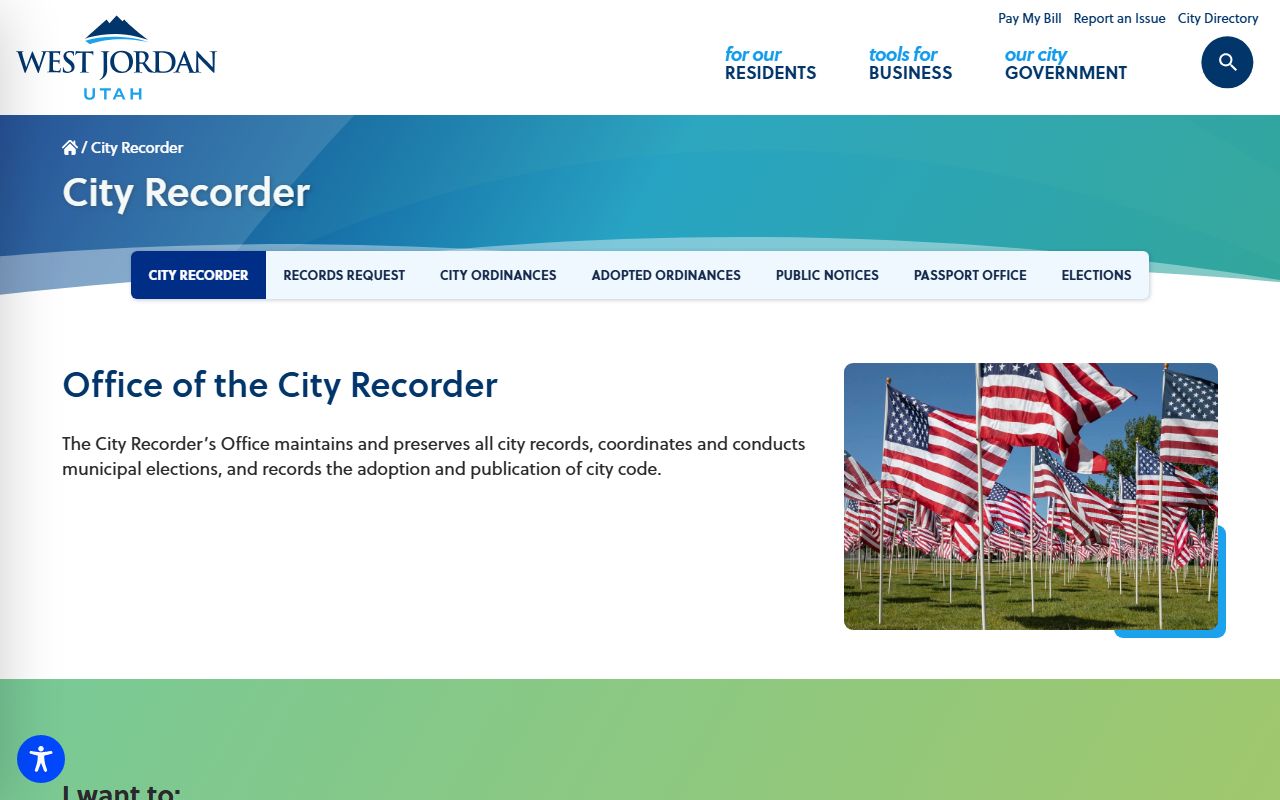
The image reflects the city-record side of the search, but the historical society is where many older West Jordan family clues are tied back to place, artifact, and story.
When you combine the society with the recorder, you get both sides of the timeline. The recorder tells you what the city officially keeps, and the historical society helps you interpret the local history behind the family name. That is a strong pairing for West Jordan Genealogy because it respects the difference between municipal records and community memory.
West Jordan Genealogy Before 1941
Before incorporation, West Jordan families were part of a broader Salt Lake County and Utah record environment. That means county clerk and recorder files, Utah Vital Records, cemeteries, newspapers, and state archives are all more likely to produce the evidence you need than the city recorder. For older households, the city name may appear in a church record, a newspaper notice, or a land reference long before it appears in a municipal file.
Start with the county and state tools that best match your date range. The Utah State Archives can preserve government context, Utah Digital Newspapers can supply family notices and obituaries, and Utah Cemeteries and Burials can help you identify burial places that connect the family to the area. The FamilySearch Utah Genealogy wiki is also useful for sorting the record groups before you spend time in the wrong repository.
West Jordan Genealogy and Salt Lake County
Salt Lake County is the county-level framework for West Jordan Genealogy, especially for families who were in the area before the city incorporated. County records can provide marriage, deed, probate, and other civil evidence that the city recorder will not hold. If you are tracing a West Jordan family over several generations, county records often give you the fixed points that make the local history understandable. The county seat in Salt Lake City also means many older family paper trails are concentrated in the same metropolitan area.
The Salt Lake County Genealogy page is the right next step when a West Jordan search needs more than a city record. Use it to move from one household clue to the broader county record set, then come back to West Jordan's local history sources if you need neighborhood-level context. That is especially helpful when a family appears in land or burial records but the city office does not have a matching file.
Salt Lake County Genealogy is the county companion for West Jordan research.
West Jordan Genealogy Statewide Resources
Statewide collections round out West Jordan Genealogy. The Utah State History site can help with local place context, the Utah Vital Records office gives the state certificate path for modern events, and the CDC Utah vital records page helps confirm what is available at the state level. If you need a broader local-history roadmap, the Library of Congress Utah local history guide and the Utah Population Database can be helpful reference points.
Those sources are especially valuable for a city like West Jordan, where the municipal record set is relatively young but the settlement history is much older. A family may need to be traced through county, newspaper, cemetery, and state records before the city record side becomes relevant. That is normal for West Jordan Genealogy and usually the fastest path to a correct conclusion.
West Jordan Genealogy Research Path
The most efficient West Jordan Genealogy search starts with the city recorder if the record is post-1941, then moves to the historical society for local context, then out to Salt Lake County and Utah state collections for the earlier family trail. That order keeps the date range aligned with the right repository and prevents you from looking for an 1890s family in a 1950s municipal file.
West Jordan has enough local history to reward a careful search, but the records are split by era. Once you match the era to the office, the city story becomes much easier to reconstruct and verify.