
Grand County, Utah Genealogy
Grand County Genealogy is tied to a later county creation date, a river name, and a compact county seat that makes the search path surprisingly manageable. Grand County was created from Emery County on March 13, 1890, and Moab became the county seat. The county name comes from the Colorado River, which was originally called the Grand River, so even the place name carries a settlement story. That background matters because the record trail begins after the county itself was organized, giving researchers a clean framework for marriages, property, probate, and court work from the 1890s forward.
Grand County Genealogy Offices
The Grand County Clerk is the main starting point for many Grand County Genealogy searches. The office keeps marriage records from 1890 to the present, birth and death records from 1898 to 1905, and probate, court, and land records from 1890 forward. The clerk is at 125 E Center Street in Moab, UT 84532, the phone number is 435-259-1321, and the office is open Monday through Friday from 8:00 AM to 5:00 PM. Those dates make the clerk the best first stop when a family appears in Grand County after 1890 and you want to decide whether the next clue is likely to be a marriage, a probate packet, or a court file.
The Grand County Recorder covers the property side of Grand County Genealogy. The office keeps land records from 1890 to the present and handles recorded documents, mining claims, and mineral rights records. It is also at 125 E Center Street in Moab, and the phone number is 435-259-1343. Those records matter in a county where land use, mineral rights, and residence patterns can overlap in ways that are not obvious from a marriage entry alone. A property file can tell you more about where a family lived than a single census line will.
Lead-in source: Grand County.
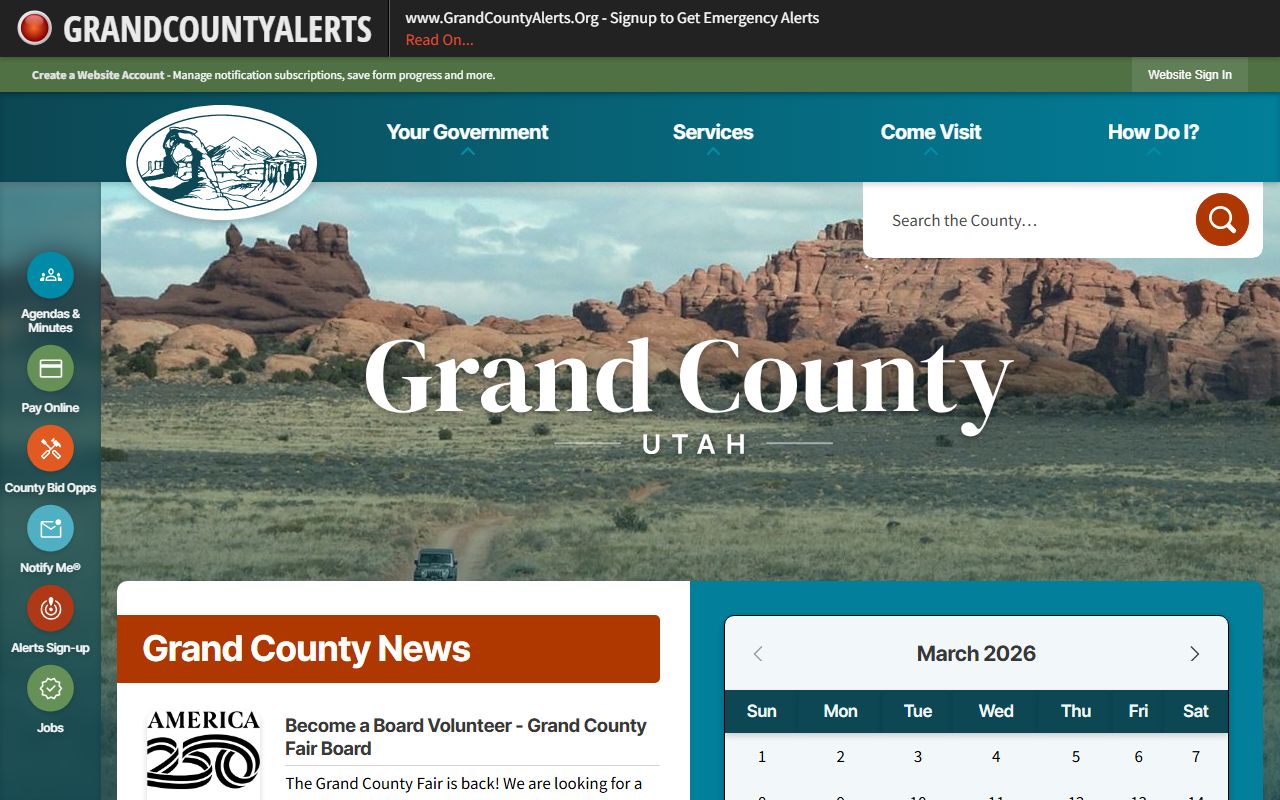
The county home page is a useful anchor because it keeps the county seat, the local offices, and the current government structure in view. When you are sorting out record dates or confirming an office address in Moab, that visual cue is a practical way to stay oriented.
Grand County Genealogy Records
Grand County Genealogy records begin after the county was created, which keeps the timeline easier to manage than in some older Utah counties. Marriage, probate, court, and land records all begin in 1890, and the early vital register covers 1898 to 1905. That means you can often stay inside one county and still follow a family through several life stages. A marriage file may identify the couple. A probate entry may identify heirs. A land document may show whether the family stayed in Moab, moved to a different district, or transferred property to the next generation. The county record set gives you a continuous framework from the start of the county's civil history.
The recorder is especially important because Grand County Genealogy is closely tied to mining claims and mineral rights records. That is a real research advantage in a county where a family's property trail may not look like a standard town lot or homestead story. A mining-related entry can explain why a surname appears in one parcel, why a family remained near a certain tract, or why a transfer occurred without an obvious residential move. For descendants trying to connect family residence with work, those files can be as important as the marriage register.
Grand County was also shaped by the Colorado River corridor, which means settlement, transportation, and land use all influenced the record trail. When a surname appears in a land file, it is worth asking whether the same family also shows up in a probate packet or a court matter that reflects travel, property change, or settlement pressure. The county's compact geography helps here because Moab serves as the practical center of the record search and the surrounding property story.
Grand County Genealogy on FamilySearch
The FamilySearch Grand County Genealogy page is useful because it confirms that Grand County has no known history of courthouse disasters. It also points to Family History Library microfilm for birth and death registers, marriage licenses, probate records, and land records. That makes FamilySearch a strong planning tool when you want to know which record series is most likely to hold a family clue before you visit the clerk or recorder. In a county where the record runs start in the 1890s, a good planning tool can save a lot of unnecessary searching.
FamilySearch is helpful in Grand County because the county record base is early enough to be useful but still straightforward enough to manage. A marriage date from 1890 can be checked against later property work. A probate entry can be compared with a land transfer. A birth or death register can be lined up with a newspaper notice to confirm the same family story from more than one angle. The value is not only in the record list itself, but in the way the list helps you decide which part of the county archive to approach first.
The page is also a good reminder that Grand County genealogy works best when you do not assume the answer is in one source. FamilySearch can guide you to the right county book, but the actual research still improves when you return to the clerk, the recorder, or later state and newspaper material for the proof. That keeps the county records at the center while still using FamilySearch as a map rather than a destination.
Grand County Genealogy Newspapers
Utah Digital Newspapers is a useful companion to Grand County Genealogy because local news can show details that a county record only hints at. Obituaries, marriage notices, land notices, and short community items can identify relatives, dates, and neighborhood ties. That is especially useful in a county like Grand, where a family may be tied to Moab, ranching, or mining work and leave a trail that crosses several different document types. Newspaper notices often supply the connective tissue between a county entry and the next generation.
Utah State Archives and Utah State History add the broader context that can turn a record search into a family narrative. Archives help when you need government context or a wider record series. State history helps explain settlement patterns and the county's place in southeastern Utah. When a family appears in a district, a newspaper item, or a property transfer, those state resources can suggest why that household settled where it did and how it may have moved over time.
The county record set and the newspaper record work well together because they answer different parts of the same question. The clerk and recorder give you dates and property. Newspapers give you relationships, occupations, and timing. For Grand County Genealogy, that combination is often what makes a family branch confident enough to document rather than guess.
Grand County Genealogy Strategy
Use the clerk first when the record is civil and the recorder when the record is about land, mining claims, or mineral rights. Grand County Genealogy tends to reward a simple sequence because the county seat is Moab and the office structure is compact. If the family first appears in the 1890s, the county likely has a relevant marriage, probate, or property trail. If the family is later, you can still use the same offices, but the record type you need may change. Staying tied to the date range keeps the search from becoming too broad too quickly.
Keep Moab in mind as the pivot point for the county search. It is not just the county seat; it is also the place where the civil, land, and local-history trail comes together. Pair the county books with state archives, state history, and newspapers when you need to understand how one generation led to the next. That is often the fastest way to move from a name in a ledger to a household in context, especially when the same family appears in both property and mining records.
Grand County Genealogy becomes most accurate when you treat mining claims and mineral rights as family clues, not just technical paperwork. The county's record structure is strong enough to support a multi-step search, and the sequence usually works best when you start with the office that matches the date and the event instead of trying to use every source at once.