
Iron County, Utah Genealogy
Iron County Genealogy reaches back to one of Utah's original counties, which gives the record trail a deep territorial feel even though the county's name points to the iron mines west of Cedar City. Iron County was created in 1850, with Parowan as the county seat and Cedar City as the largest city. That long history matters because the county clerk and recorder preserve records that can connect a household across marriages, probate, land, and later vital records. When a family settled in Parowan, Cedar City, or one of the surrounding communities, Iron County usually has enough depth to build a reliable timeline without forcing the search into a different county too soon.
Iron County Genealogy Offices
The Iron County Clerk is the main county starting point for Iron County Genealogy. The office keeps marriage records from 1887 to the present, birth and death records from 1898 to 1905, and probate and court records from 1851 forward, with land records from 1852 forward. The clerk is at 82 N 100 E in Parowan, UT 84761, the phone number is 435-477-8340, and the office is open Monday through Friday from 8:00 AM to 5:00 PM. That combination of early probate and later marriage records makes the clerk especially useful for families who stayed in the county across several generations and left different record types at different life stages.
The Iron County Recorder handles the land side of Iron County Genealogy. The office preserves land records from 1852 to the present and maintains recorded documents, property information, mining claims, and mineral rights records. The recorder works from the same Parowan address and same weekday hours as the clerk. For a county with iron-mining roots, that record set can be just as important as the marriage books because property and resource history often explain why a family settled where it did and how long it remained in a given district.
Lead-in source: Iron County Clerk.
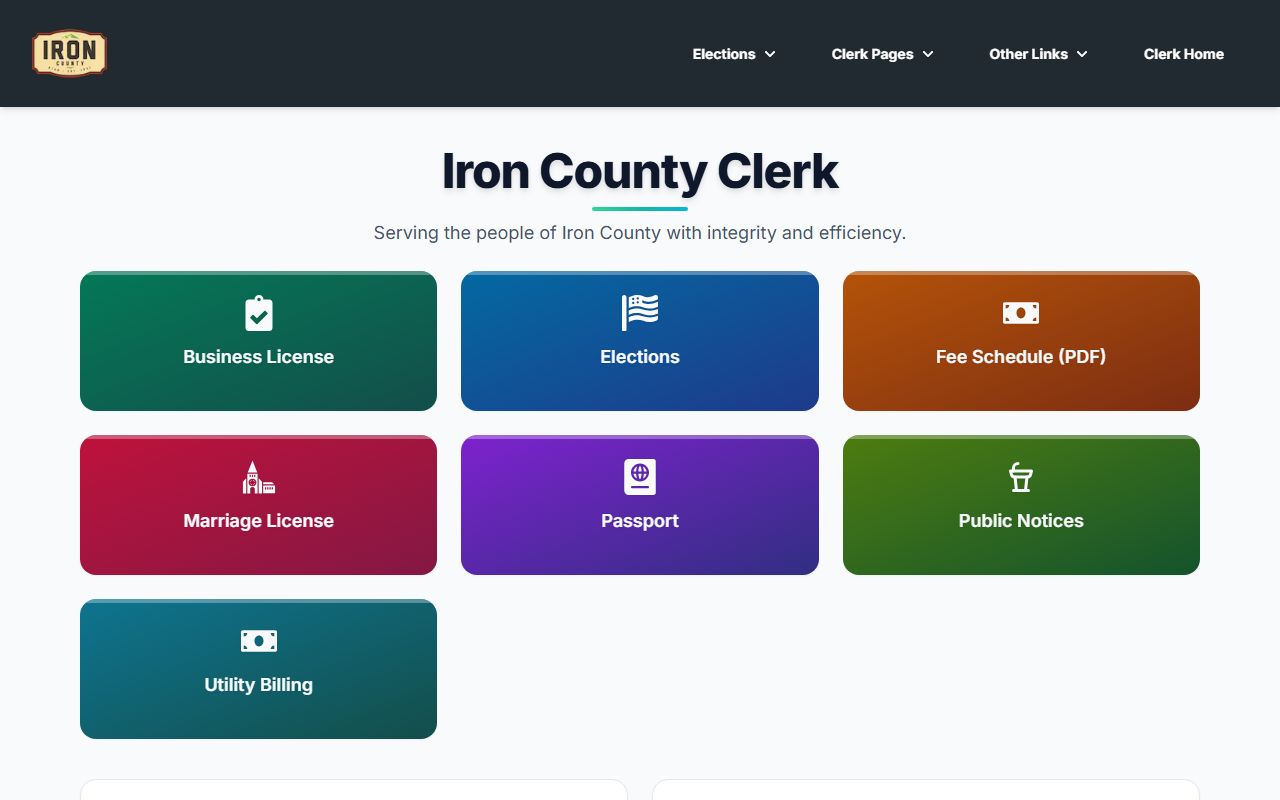
The clerk image is a good anchor for Iron County Genealogy because it points directly to the office that carries the county's marriage and early vital record trail. It also keeps Parowan in view as the practical center of the search, which matters in a county where settlement history and office geography are closely linked.
Iron County Genealogy Records
Iron County Genealogy records cover a long and useful run. Marriage records begin in 1887. Birth and death records begin in 1898 to 1905. Probate and court records go back to 1851, and land records begin in 1852. That means a family may appear in several record groups at different life stages. A marriage entry might show the beginning of a household. A probate file might identify heirs. A land file might show the transfer of a ranch, a town lot, or another piece of family property. The county's early record structure gives researchers multiple chances to connect the same surname across time.
Iron County's original-county status matters too. Because the county was created in 1850, it has records that reach back to the first years of territorial settlement. That makes Iron County Genealogy especially valuable for families who lived in Parowan or Cedar City before county boundaries changed elsewhere. If a name seems too early for a marriage entry, the probate or land trail may still reach far enough back to make sense of the family. The county name itself, tied to the iron mines west of Cedar City, is a reminder that economic history and family history are often the same story here.
The county setting works as a visual reminder that Iron County Genealogy should be read as a settlement story, not just as a list of record dates. When a family line moves through Parowan and Cedar City, the county's geography and record sequence usually tell the same story in different ways, especially when a land transfer or probate file confirms why the family stayed in one settlement or shifted to another.
Iron County Genealogy Vital Records
Later Iron County Genealogy work often moves into modern vital records. The Southwest Utah Public Health Department serves Iron County and provides certified copies of birth and death certificates. That matters because county-level registers are not the same thing as the later certificate system. Once the family event falls outside the clerk's early register window, the health department becomes the more useful route for a copy or a certification request, especially when you already know the family stayed in the county but the event happened later.
For state-level context, Utah Vital Records and the CDC Utah vital records page explain the broader Utah certificate path. Those sites are useful when the county's early register stops but the family event is later. They also help make sense of how county records and state records divide the work in Utah genealogy. Utah Code Title 26 is useful when you need to understand why the county record run ends where it does and why the later certificate process belongs elsewhere.
Iron County Genealogy is often simplest when you treat the county clerk as the early record source and the health department or state office as the later record source. That keeps the search pointed at the right time period from the beginning and avoids ordering the wrong kind of record for the event you are tracing.
Iron County Genealogy on FamilySearch
The FamilySearch Iron County Genealogy page confirms that Iron County has no known history of courthouse disasters. It also points to microfilmed county records including birth certificates from 1903 to 1914, marriage licenses from 1887 to 1966, death certificates from 1904 to 1965, probate records, land records, and court records. That coverage makes FamilySearch a strong planning tool before you request a copy or make an in-person search, especially if you are trying to decide whether the county clerk or the recorder is the right place to start.
FamilySearch helps Iron County Genealogy because it shows how broad the county record base really is. If you need a birth date, a death date, or a marriage license year, the FamilySearch summary tells you what period to check first. If you already have a family in the county, the microfilm note can point you toward probate or land records that may hold the next clue. The no-disaster note matters too, because it means researchers can often trust that the early run survived well enough to support a multi-generation search without immediately assuming the books were lost.
The page also helps you keep the county timeline straight. An 1887 marriage is one kind of clue, but a 1904 death register or a 1910 birth certificate may be the record that connects the next generation. In Iron County, where families often moved between Parowan and Cedar City, that kind of date discipline is the difference between a tentative guess and a solid lineage.
Iron County Genealogy Newspapers
Utah Digital Newspapers is a strong companion to Iron County Genealogy because local notices can show the details that county records only hint at. Obituaries, marriage announcements, business notices, and short local items can identify relatives, dates, and neighborhood ties. In a county with two major settlement centers, newspaper notices often help determine whether a family was rooted in Parowan, Cedar City, or one of the smaller surrounding communities. That kind of distinction matters when the same surname appears in more than one place.
Utah State History, the Library of Congress Utah local history guide, and Utah State Archives add the broader context that helps Iron County records make sense. They can explain settlement patterns, county development, and how local records were preserved. When a family appears first in land, then in marriage, then in probate, those wider resources help explain why the sequence looked that way and what it says about the family's place in the county.
The county record set and the newspaper record work well together because they answer different parts of the same question. The clerk and recorder give you dates and property. Newspapers give you relationships, occupations, and timing. For Iron County Genealogy, that combination is often what makes a family branch confident enough to document rather than guess.
Iron County Genealogy Strategy
Begin with the date you have, then match it to the right office. Iron County Genealogy tends to go fastest when you check the clerk for marriage, probate, and early vital records, then use the recorder for land and mineral history. If a family is tied to Cedar City, the land trail may explain the move better than a marriage entry. If a family is tied to Parowan, the probate trail may explain the household structure better than the census alone. The county's office geography keeps that workflow practical because both offices sit in the same county seat.
Do not stop with the county books. Newspaper notices can show a funeral or marriage announcement, and state archives can help when you need older government context. Iron County Genealogy also benefits from keeping the settlement history in mind, since the county's mining name and original-county status both affect how the records fit together. That historical awareness makes it easier to avoid pulling the wrong family branch and helps you interpret land and probate records as part of the same family story.
Iron County Genealogy often becomes clearer once the property record, the marriage record, and the local history are read as one timeline instead of three separate searches. When the county seat, the record span, and the settlement pattern all point in the same direction, the family line usually becomes much easier to document with confidence.